

Share this Article
“Have you ever thought that when you’re on a call, you could strategically use your voice and speech melody to be more persuasive, and perhaps redirect the behavior and change the direction of that call?”
This is a question presenter Liz Peterson asked the audience at the 2019 Collector Live virtual conference. Peterson has worked as a speech language pathologist for 23 years, specializing in strategic business communications skills and voice placement. She teaches techniques that help anyone–like those in accounts receivable who work to collect payments–to be more persuasive, motivate and redirect consumer behavior and bring in more revenue.

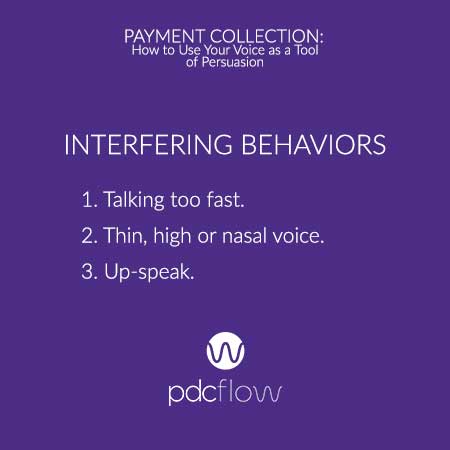
Interfering Behaviors
Before learning to use your voice correctly, you must be more aware of the bad habits you most frequently fall into. Peterson calls these habits “interfering behaviors.” When not speaking mindfully, people typically fall into one of the three interfering behaviors below.
Talking Too Fast
During conversations, brains are working hard to decode the language they hear. The faster someone speaks, the harder our brains have to work to keep up. Slowing down can really help others process the message you’re trying to send.
Thin, High or Nasal Voice
It is common to use a telephone voice that is different from your regular speaking voice. Many people have a tendency to sound thin, high or almost nasal in telephone communications with consumers. This can be off-putting to those you’re speaking to and does not show power or strength.
Up-Speak
Up speak is something many people struggle with, but often don’t notice. It is the tendency to end most or all sentences on a higher note (almost as though every sentence is a question). This speaking pattern makes people think you are immature, which takes away your credibility.
Voice Skills to Increase Persuasion
Once you are aware of the interfering behaviors that may be holding you back, you are ready to learn about the skills you can adopt to replace your bad speaking habits. During her talk, Peterson discussed two main skills you can learn to increase your persuasion and help you collect more revenue.
Pitch
Pitch is how high or low your voice sounds. There are two types of pitch individuals tend to use when speaking:
- Habitual pitch - Habitual pitch is the high to low range of your social voice. It is usually not ideal for commanding authority in a business setting.
- Optimal pitch - Optimal pitch is the range in which “your vocal folds (or cords) function at their best to deliver tones that are rich, strong and powerful,” explains Peterson. Speaking in lower, rich tones can actually de-escalate calls with upset or angry consumers.
This ideal voice pitch can be found when you touch your tongue tip to the roof of your mouth and say “uh.” Try this a few times, then add counting “one, two, three” to get a sense of how it feels and sounds to speak in this pitch. Another strategy is to begin at a high pitch, making an “ahhh” sound. Sigh gradually while lowering your pitch. Once you feel your voice get deeper and feel its strongest, you have found your optimal pitch.
When a call with a consumer gets emotional, tension (and pitch) can rise. Being intentional about speaking in lower tones of optimal pitch can calm consumers, saving a customer interaction from getting out of hand. This will come in handy when dealing with stalls and objections consumers give to making their payments.
Intonation
Intonation is the rhythm and melody behind your pitch patterns. When used properly, intonation can help you deliver your message in a confident, decisive manner. To learn how to use this melody and rhythm to your advantage, Peterson teaches the “Staircase Strategy.”
To learn proper intonation, she advises speakers to envision stepping down a staircase through their words. To practice, start off speaking in your natural tone. Step up to the top of the “stairs” at the beginning of a statement and come down a step for each syllable until your statement has ended. For longer statements, repeat the process two or three times within the statement.
Impact of Using These Voice Skills
When combining intonation and pitch, you can strategically alter the course of a conversation, often using these skills to persuade. Those who speak with controlled intonation and from the lower voice (pitch) will also show leadership through communication. This happens by:
- Making you appear calm, even in heated conversations
- Training you to speak at the right rate of speed, showing you are in control of your emotions
- Displaying vocal tones that are rich and intonation that is intentional, showing your strength through your voice

Voice Practice
Practicing any new skill is the key to success. Once you have a handle on your strongest optimal pitch and melodic intonation, it’s time to become comfortable combining them. Peterson suggests both functional practice and real-world practice.
Functional Phone Practice
For functional practice, try these three sample statements an accounts receivable representative is likely to encounter.
- Hello, may I speak with Jane Doe please?
- My name is _____ and I am with _____.
- How about we collect $100 today and we can take it on a credit card.
Real World Practice
Real world practice is what will get you most comfortable with your new pitch and use of intonation. Keep in mind, it takes three weeks to learn a new behavior. During this time, it is important to practice as much as possible.
Peterson suggests using “red light drills.” Any time you find yourself stopped at a red light while driving, speak out loud. Observe the people, places or things you see around you speaking with optimal pitch and intonation. Doing this will put you at ease with your stronger, more powerful and persuasive speaking voice.
To learn more about Liz Peterson’s public speaking courses and onsite team training availability, visit her website: https://www.speechandvoice.com/
To keep these tips handy in an easy-to-access format, download the PDF:
