
If you receive a bill months after a service, how likely are you to remember what it’s for? What if you try to pay but mailing a check or calling an office during your work hours are the only options? As consumers, none of us would be happy if we were put in these positions. So why do we expect healthcare patients to deal with these issues?
Privacy roadblocks and the inability for systems to work together have created an inadequate patient financial journey. At the same time, high deductible plans and the prevalence of health savings accounts are involving consumers in the financial end of their care more than ever before.
How do we solve the problem of fine-tuning back office processes and patient experience simultaneously? By investing in technology.
Why Modernize Your Patient Financial Journey?
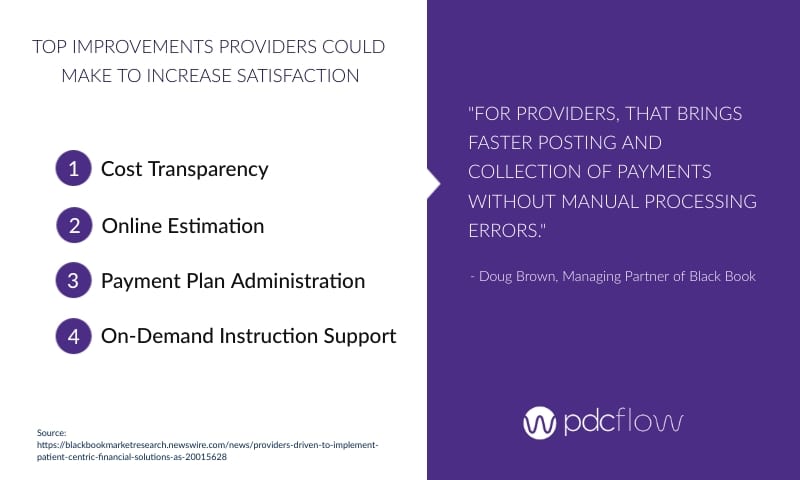
Create a Better Patient Financial Experience
Patients are more likely to pay bills on time if they are informed and invested in the billing and payment process. Using the newest tools to engage patients makes them feel empowered. Creating this positive payment environment:
- encourages prompt payment
- encourages better communication from patients when they need help with financial aid or require a recurring payment schedule
- creates repeat patients to your healthcare facility
- increases likelihood of good and decreases chances of bad online reviews
Shorten Your Revenue Cycle
Of course, the direct benefit to your medical facility is that happier, more informed patients pay bills faster. When they know where to go to pay, understand how to read their bill and are offered payment channels that are the most convenient, patients will resolve what they owe.
When your facility creates a system where patients are more willing to pay, you speed up the entire revenue cycle from start to finish.
Where Can You Modernize the Patient Journey?
Registration
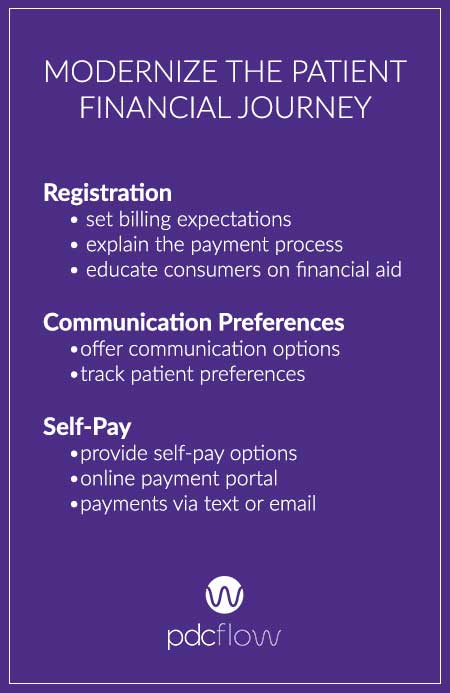
As one of the first interactions consumers have with your facility, registration is a great place to set expectations. You can use this time to explain the payment process and educate consumers on financial aid and payment plan options. You can also explain the communication methods you offer for future notifications.
There are many multifunction software tools available to help you share these messages electronically with patients. PDCflow’s FLOW Technology offers items like HIPAA compliant document delivery with eSignature requests that help you deliver disclosures and other pre-check in documents.
It can be used to complete other check in tasks at the same time through photo uploads to collect insurance information and payment requests to collect copays. Performing all of these tasks electronically makes check in faster, and also sets expectations for other electronic means of communication your office offers.
Collecting Communication Preferences
Offering multiple communication options, such as email and text message notifications, helps you cater to the modern preferences most patients prefer. Providing choice makes patients more eager to participate in their care all the way through to payment.
Take care, however, to find tools that help you monitor the patient preferences you collect. It’s important to know what channels your patients have opted into and out of. Sending information to the wrong channel will decrease likelihood of payment – or even cause more serious problems if opt outs are being ignored.
Self-pay Enhancements
Implementing a Modern Patient Financial Journey
Training and Company Culture
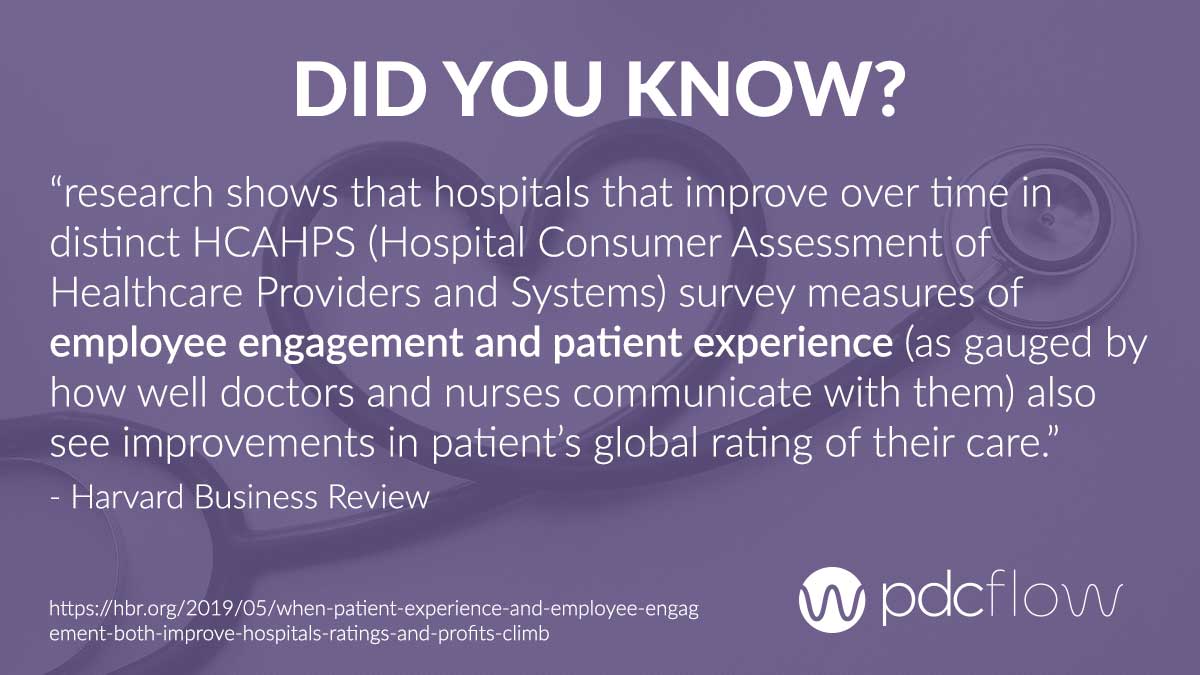
No matter how easy your new processes are, you will need to get front line employees prepared for the change. Part of this preparation is explaining the technical processes you are implementing. You may find, though, other tasks will involve emphasizing parts of your company culture that promote positive patient interactions.
- Software training: uses and workflows – After adopting your new digital tools, you will need to create a training plan. Include information regarding who is responsible for what tasks, any templates or workflows you want staff to use, etc.
- Consumer connection: practicing empathy – For times when patient interactions are necessary, like when collecting past due payments, you should build empathy training into your processes. Medical procedures can be stressful and costly. It’s essential your billing staff understands the pressures patients may be feeling during payment.
- Identifying payment issues: Recurring schedules and financial aid – Along with empathy during collection, it’s best to train staff to identify patients who need financial aid or would benefit from a payment plan.
Aside from one-time and recurring training programs, you can reinforce these best practices of patient collection within the office setting through company culture.
Patient-Friendly Software
It’s essential that any new tools you implement into your practice are easy for patients to use. PDCflow’s software, including our FLOW Technology, is designed for fast, convenient patient experiences.
- Photo uploads, electronic document delivery, eSignature and payment requests can all be used during check in and throughout the payment process. These flexible, mix-and-match features allow FLOW to facilitate already existing processes, enhancing the patient financial experience with minimal disruption.
- PDCflow’s payment software includes a flexible recurring payment scheduler that allows patients to choose payment intervals and amounts that work for them. The system also allows your administration to set minimum and maximum terms to avoid payment plans that stretch on for too long.
- In healthcare, you may require special settings to maintain control over staff’s permissions based on group, physical location or even their department. PDCflow’s Organizational Hierarchy features allow you to choose who can access certain templates or reports, minimizing the errors during billing and payment.
Interoperability
Extra Help – Extended Business Offices
You may find that choosing and implementing the right technology for your healthcare organization is beyond your current resources. If this is the case, you may consider looking for an extended business office (EBO) that can perform these payment collection functions for you.
If this is the route you decide to take, look for an EBO that offers these digital enhancements as part of their services, so you can take advantage of their payment tools as part of your billing process.
If you don't know where to start in enhancing the financial journey for your patients, consider PDCflow's FLOW Technology. Download this Solution Brief for Healthcare to learn how FLOW reduces risk, keeps you compliant with PCI and HIPAA regulations and speeds up your revenue cycle.
Download the FLOW Technology for Healthcare Solution Brief
- ABOUT THE AUTHOR -

Hannah Huerta, Marketing Specialist
Hannah Huerta is a Marketing Specialist at PDCflow. She creates content for the accounts receivable and payment industry.

Related Articles